
Almost two years ago I wrote a piece called 5 Tips For Making Your Next Career Decision in 2022. It was a mixture of macro analysis for the state of the tech industry at the post Covid era. A short collection of advise on how to use that time to make smart career decisions, though most of them are relevant at any time. Lastly, that article contained a whole lot of, not so cleverly disguised, foreshadowing for what eventually came to pass between 2022 and 2023 in the tech industry.
I avoided the temptation to write a follow-up article during 2023, frankly because I didn’t feel like I have anything productive to suggest. To those that got laid off and approached me, I mostly offered my kind words, and attempted to help them in finding a new place. Those that came to me for advice on making a career change, usually got the same answer: “Unless you are extremely unhappy, it’s best to stay put and weather the storm”.
It was an unfortunate year for many people for various reasons, whether it was war, cutbacks, inflation, or any other smaller crisis in between.
In the Tech market, companies realized they cannot stay unprofitable much longer given the changing economic backdrop. Under the looming threat of stock selloffs for public companies, and funding drying up for private ones, it all gradually lead to the same understanding: Revenue needs to increase, operational costs need to be cut.
For many companies that meant primarily one thing: Mass layoffs.
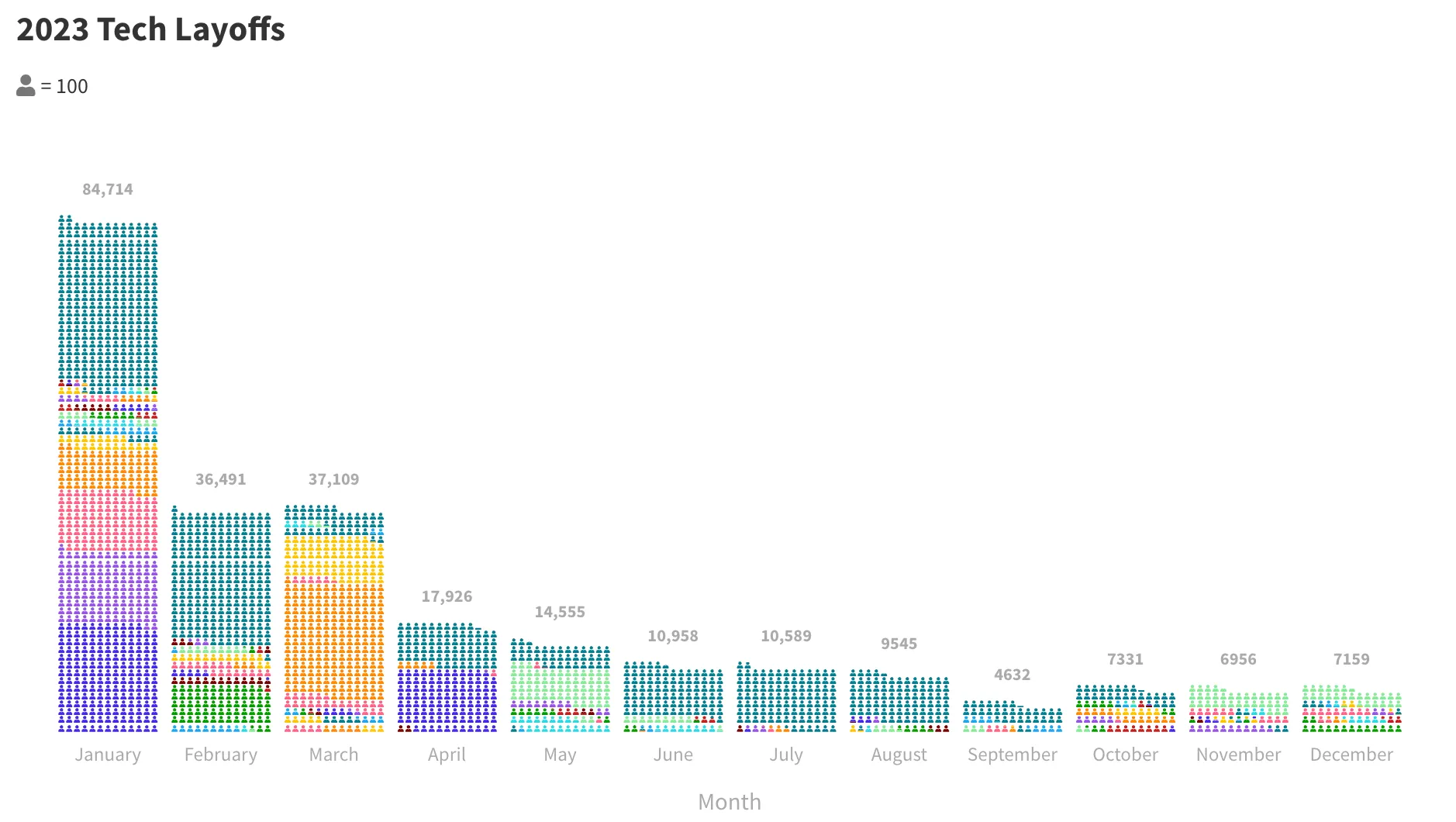
Tech layoffs in 2023 (TechCrunch)
Now as we are hopefully at the tail end of the roughest year in tech of the last decade, a reasonable question would be: What has changed, and how should it impact my career in the tech industry?
As with last time, I’ve collected my perspective on these times in the form of “tips” or suggestions, that hopefully could be beneficial guidance to you starting off the year.
It is important to say that as of writing this, we are just kicking off 2024, and still uncertainty is up in the air. So as you are reading this, know that much could change later in the year or might already have.

This empty seat could be yours (EyeEm on freepik)
It’s Not The Best Time To Be A Manager
I’m an R&D Manager, so I know very well that I’m writing this from inside of a glass house. But if there’s one thing many companies have discovered in the past couple of years, and it’s that we probably don’t need as many managers, team leads, scrum masters, project managers, or basically any type of “non-coders” as we got used to.
This trend gained traction in early 2023 when tech industry leaders Elon Musk and Mark Zuckerberg, both unequivocal role models for senior tech managers worldwide, publicly acknowledged that Twitter and Facebook have been growing unproportionally large and expensive managerial layers over the years.
When trying to understand why, they found that this was happening in their companies solely to create growth avenues for frustrated talents they wished to retain, and feeding the already glutted “corporate beast”. So their way of improving efficiency was telling all those people to either go back to coding or go home.
Which lead other companies around the world to follow suit.
So, should you give up on your plan to become a manager? Not necessarily, but it really is a good time to reconsider your motivation. Assess whether a management role is a true career goal for you or simply a misguided way to ascend the corporate ladder or earn more money.
Because if there’s one thing these past couple of years have reminded us: The best way to be consistently hired and stay employed is by being hands-on.

Keeping it sharp (drobotdean on freepik)
It’s The Right Time To Sharpen Your Pencil
If you were to ask a group of engineers out there looking for a new job about their experience, probably more then ever you will hear radically different experiences. Some will tell you about an abundance of intriguing and exciting positions that are offered to them, while some are finding it hard to get an interview in a decent company.
The reality is that there is still quite a lot of demand for tech talent out there, but it shifted it’s nature. As companies realize they can no longer hire and grow endlessly as they did in previous years, the stakes when looking for new talent are becoming much higher. They cannot afford hiring people that won’t bring definite impact, because they don’t know when or if they could hire someone else or re-hire.
In other words, companies are getting pickier.
If a couple of years ago you could get hired into a job you might be under-qualified for, assuming the hiring team believed you could grow into it, nowadays it’s much less common. That means having immediate value and a competitive edge is more important than ever to get to where you want to get.
You need to put more effort, invest the time to learn new skills and acquire new knowledge. This is true regardless of if the place you want to grow to is within your current company, or a shiny new job somewhere else.
Learn some new technologies related to the domain that you are intersted in, study complex architectures from your company or others, practice your soft skills, learn how to effectively leverage AI, anything that would give you an edge that could make you stand out in a crowd of other engineers on your level.
Be Cautious Of The Hype Trains
Two years ago it was all about Blockchain, Cryptocurrencies, NFTs, Web 3.0, and some re-emerging focus on Fin-Tech and Cloud Cyber Security. While non of those really went away, we since understood that probably decentralised web and finance sound better on paper than their real life applications. We understood that we probably don’t need hundreds of crypto currencies, and dozens of niche cyber security products that all roughly do the same thing. And for sure we saw many start-ups going bust, both of the well intentioned and the not so well intentioned types.
Enter 2024, the attention of the tech industry has shifted to a whole new prospect: Generative AI… Boy-o-boy is the hype real this time.
Really there are very few companies that are not trying to brand themselves right now as “AI companies” or at the very least find ways to integrate (or shoehorn) Gen AI into their day to day.
Now to be fair, unlike previous flashes in the pan, Generative AI does seem to be here to last, one way or another. It already revolutionized software development velocity and creativity for those smart enough to leverage it. It gave birth to new skills or even professions like prompt engineering, and we have probably only seen the tip of the iceberg where it comes to enterprise applications.
Familiarizing yourself with the ecosystem, tooling and practices is the smart thing to do, if not even a must at this point. But defining your career based on that, well that’s a bit of a different story.
Many of the newborn companies that have popped up during the past months, touting themselves as the “Gen AI revolution for X”, might find themselves very quickly knocked out of the race by the bigger players or by new breakthroughs that could render last year’s innovation obsolete.
Becoming a prompt engineer in 2024 might sound like an exciting new career opportunity or even a step into the tech world for those less technically savvy. But do you believe that it will remain a sustainable career avenue 5 or 10 years into the future? Only time will tell.
For now at least, you should be cautious and mindful of how you decide to board the AI hype train.
Which leads me to my last point…

The basic tools (Barn Images on Unsplash)
First Principals Remain The Same
I wrote this two years ago, and I will write it again: I do not think the way you make career decisions should be greatly influenced by market conditions or employment trends.
Yes, your timing and state of the tech ecosystem change things. They may change the opportunities available for you and they may change your personal priorities. But your career spans much further than one good or bad period. The first principals for what matters the most in building your career remain the same on the long run.
You should figure out what is the type of company that suites your needs. If it’s in the style of work that fits you best, types of business, domain or tech challenges the company focuses on, or even simply the compensation model if that is what matters most for you.
Think about where you want to be in 5 years, and what type of change could get you closer there, even at the cost of taking a step back temporarily.
But most important over all, consider the company’s culture.
Culture trumps all, and if the culture of the company you end up in does not fit yours, it doesn’t matter how much money you make or how bleeding-edge the tech stack is, you will end up miserable very quickly.
While these are still times of uncertainty for many of us, I do believe that these are times of opportunity. Things might be far from perfect, and you will find you need to work harder and might have to compromise where needed, but the chances are there for those willing to grab them.
First published on Medium, 24 January 2024.