
Imagine this. You are an R&D manager in a successful tech company that has been transitioning into a remote-first work model.
Things are doing well, the teams are figuring things out, communication might not be the same as it used to be, but the engineering group is still delivering well and some people are even doing better than they did before.
But then one day, you get an urgent email from the company’s CISO, the guy responsible for information security and all that jazz, and it’s a scary one.
In the email he explains that he has begun conducting an investigation revolving a potential security breach his team might have detected. What they discovered, his email suggests, is daily access to your private company network coming from Chinese addresses. All of which is pretty alarming considering your company does not employ anyone in China.
Moreover, he is telling you all of this because the access was traced to non-other but the account of one of your employees.
His name, is Bob.
Bob, is a software developer in his early 40s, he lives together with his two cats in a condo at the better part of the city. In his spare time he likes to trade 80s memorabilia on eBay and watch cat memes and videos on reddit.
Bob has been working in your company for a while. He is the type of person you would describe as “inoffensive and quiet” for a lack of better things to say. He is versed in several programming languages and is considered a very talented developer by his peers. You don’t get to see him often now that things are remote, but you do know he is delivering well on all of his projects and KPIs, even though if to be truthful you are not exactly sure what he is working on all the time. So what on earth is Bob doing in China?
Well, Bob didn’t travel to China. Actually he is afraid of long distance flights and hates asian food. What Bob did do however, is outsource his day-to-day work to a tech contractor firm residing in Shenyang, China.
For months he would send all his tasks and coding assignments to remote developers, paying them a fraction of his six-figure salary, while he spent his days watching cat videos and bidding on eBay. He even FedExed them his physical RSA security token, the one used to uniquely authenticate him to the company’s most sensitive virtual assets.
Once in a while he would go on a meeting if he had to, and at the end of his day he would send an update email to his manager about all the things he had accomplished.
Bob didn’t only do it in the company you are working in though, so don’t feel bad for being the only one not noticing. Bob was actually running the same swindle in multiple companies in the area, all at the same time.
Believe it or not, this is a true story and it pretty much sums, to an extreme, the fear engineering managers all over the world have developed and had to deal with for the past couple of years.
Being dragged into a pandemic driven remote work model, they all had to ask themselves: Do I actually trust my employees if I can’t see them all day?

Are You Working Over There? - Photo by Noelle Otto on Pexels
The Basics of Trust
But before we talk about us, pre or post pandemic, we should probably start with the basics. Why do we care about trust so much?
Bob was doing well, even more than well, all the tasks that were given to him were delivered and on time, he was considered a top performer by his peers. It was just that small wrinkle that he didn’t actually do it by himself, but delegated it to someone else that just happens to live in China.
Well we can’t all be perfect, and after all we reword delivery and performance, and we definitely value the ability to delegate. So why did Bob lose his job immediately after this was discovered?
Putting aside the security, compliance and PR risks he put his company through, Bob lost his job primarily because his employer understood that he can’t trust him. If he can’t trust him not to send his private RSA key via airmail halfway across the globe, he probably also can’t trust him with other smaller things. Can’t trust him with the quality of his work, can’t trust him with his behavior with his peers, can’t trust what he communicates and his level of transparency.
In the dry math of it all, the value brought to the company by Bob was greatly outweighed by how much he couldn’t be trusted going forward.
I know, it’s really absurd looking at things that way, because this story is so extreme and ridiculous. However as we all know, in most real life cases trust is not a dichotomy and not everything that can hurt trust is as monumental as outsourcing your work to China.
Lack of trust can be specific to things. For example, you might trust a developer with writing clean code, but you don’t trust her to test the code well enough before shipping it. You might trust a DevOps engineer with setting up new infra, but you don’t trust him not picking up a fight with his peers while doing so. You might trust a tech lead with being a technical acumen, but you don’t trust him with showing up to meetings on time.
All these cases prove that usually this value or performance vs. trust equation is much less clear-cut than in Bob’s case. Some people bring us a lot of value, but sometimes we have trouble trusting them in certain scenarios, so how should we navigate it as as leaders?
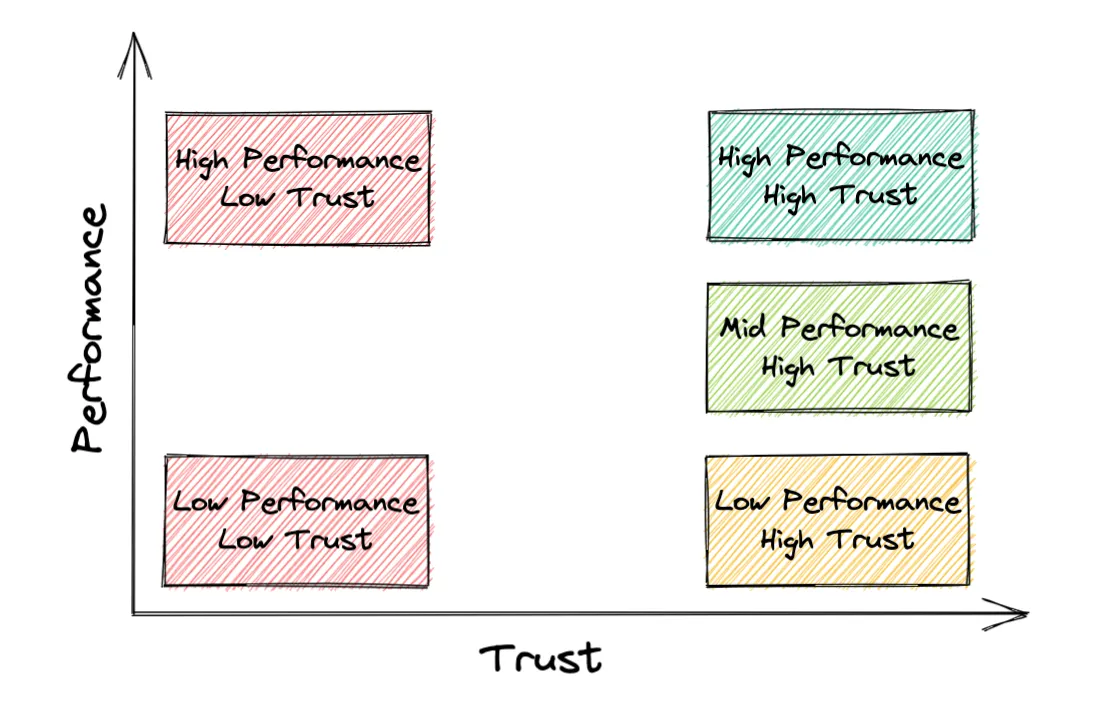
The Performance vs. Trust Matrix
Performance vs. Trust
In his book The Infinite Game, describes Simon Sinek how the American Navy SEALs, the U.S Navy’s elite operations force, chooses who to draft to the special unit “SEAL Team Six”, which are considered to be the best of the best. Their model is simple and revolves around the performance vs trust matrix in the fig. above.
Performance stands for sheer skills on the battlefield, marksmanship capabilities, how fierce of a warrior you are - In our world you can compare it to technical knowledge and analytical engineering skills.
Trust on the other hand, stands for the level of loyalty to your comrades and trustworthiness off the battlefield - In our world that would translate into teamsmanship, personal accountability and transparency.
Quite obviously the most desired comrades and leaders are those ranking high on both performance and trust, but as we all know, those are rare in any type of profession be it combat or software engineering.
It is also very obvious that no one wants in their squad those that rank low on both performance and trust.
Also, members with high levels trust but very low performance were somewhat undesirable, because while they were good people at their core, they didn’t perform well enough to be strong contributors to the squad.
But here is where things get interesting.
Through years of experiences, they’ve also discovered that those ranking high on performance but low on trust, while revered for their skills, tended to be toxic team members and even worse, very poor leaders.
The SEALs realized they would much rather take people that are average performers but trustworthy, rather than those that could prove corrosive for the team.
Once a person passed a certain threshold of competency, his trustworthiness proved more valuable than his proficiency.
Let that sink in for a minute. The Navy SEALs, one of the highest performing organizations in the modern world, where failure can be measured in life or death, would rather value trust over performance. Because they believe that no matter how good you are, if you are not trustworthy, you are a liability for the team more than you are an asset.
This is very relatable to our world, because we’ve all worked with those people, those extremely talented engineers that no one really wants to work with or befriend, you know.. the assholes.
Hack, we might have even hired one or two of them. Telling ourselves things like: “They might be a bit anti-social and shifty, but wow are they good at Java internals, we have to get them on our team before someone else does!”.
These end up being the people others don’t want to collaborate with, the people others complain about, the people we find ourselves ushering to meeting to prevent conflicts. It’s the people we find ourselves micromanaging whether we like it or not, because deep down inside, we know that no matter how good they are, we simply do not trust them. Yet we keep them around anyway. Why do we do that?
All these cases of trust or lack thereof, are a slippery slope. We all know it instinctively as people, we rather be as little associated as possible with those that we do not trust, which makes this not only the problem of an individual, but also the problem of the team.
Lack of trust is a corrosive state of mind that might start with a single person, but can spread into the entire team culture, and as long as we keep hiring and retaining those individuals in favor of others, we will continue hurting our team and eventually ourselves.

Pandemic View on Cultural Values - by freepik
Enter Covid
About 7 years after Bob’s contract was terminated, and subsequently also that of his sub-contractors in Shenyang, China, roughly 1,500 km from there in a city called Wuhan, a new strain of virus will be released into the world and it would change everything.
Within mere weeks, tech companies around the globe would find themselves transitioning into remote-first or hybrid work models, things that were foreign to most of us until that point in our career. Communication would change, team dynamics would change, the way we manage our personal time would change.
But, for the most part, we wouldn’t change as people.
While the pandemic forced us into making many changes in our day-to-day, putting pressure and strain on all of us both at work and in our personal life, we are all still the same people we were before.
Being closed in our houses, moving our communication to Zoom calls, be it with or without waring pants, didn’t truly change what we think about other people and how much we trust our peers and our employees.
So why was this period so taxing on so many engineering leaders and people managers when it came to trusting the people that they work with?
Some of it obviously has to do with us being used to seeing people all the time and depending on that as a natural tool to “get a feel” for them.
That coupled with the fact many leaders are control freaks in their core, this whole situation rubbed a lot of us the wrong way.
I would argue however that for the most part, the pandemic days haven’t made such a dramatic difference in pre-existing work related trust, as much as it placed a spotlight on two things we might have neglected to focus on before:
- Actively engaging in managing trust in our teams and retaining people based on said values.
- Our personal gaps as leaders in our ability to trust our team members.
With the two are very much interconnected.
When we talk about managing and fostering a culture of trust as leaders, it means above all that we actively engage in team building and pursue psychological safety.
How to go about doing it is probably a blog post of it’s own. But the important point is that if you don’t work towards that as a goal it will usually not happen by itself, as rarely will a group of strangers spontaneously develop the type of teamsmanship and trust you need to succeed.
It’s also important to understand, as we have already established, that the overall trust in a team is heavily affected by the mosaic of personas that composes it. As long as you are the one managing the composition of that mosaic, it’s your responsibility to orient it correctly.
In other words, if you have a low trust team member or an asshole in your team, you either need to work on fixing it or let him/her go.
If you are not sure on how to approach this, try the SEALs exercise.
Place all the people in your team on the performance vs. trust matrix, use your personal opinion as a starting point and later use the collective feedback from your team members and peers as input to adjust this mapping.
This model can help you get you better clarity on whether you are retaining and rewarding the right type of people.
On the other side, when introspecting on us as leaders, having people that we can trust in our vicinity will naturally make us more trusting towards the team in its entirety, same way it works among team members themselves.
But for leaders this doesn’t stop as a passive act.
At the risk of sounding corny I’d phrase it this way: Trust is both a noun and a verb, and the more of the verb you do as a leader, the more of the noun you are going to get. Meaning, the more you actively show trust in your team members, the more they will feel inclined to live up to the expectations set by that trust, which will eventually increase the overall level of trust in the team. This trust shouldn’t be blind of course, but it should be your default.
A high trust culture is foundational for any high functioning team, be it an elite operations unit like the Navy SEALs or just a plain ol’ software engineering team. It’s the bedrock on top of which growth and success is built and unfortunately many leaders overlook it or take a passive approach to managing it.
A change in scenery like moving to work remotely might have not changed us fundamentally as people, but it did give us an opportunity to flush out some of the weaker spots in our culture. Now it’s our job to learn from those weaknesses and improve before the next unexpected surprise knocks on our door.
First published on Medium, 4 April 2022.